Cost analysis
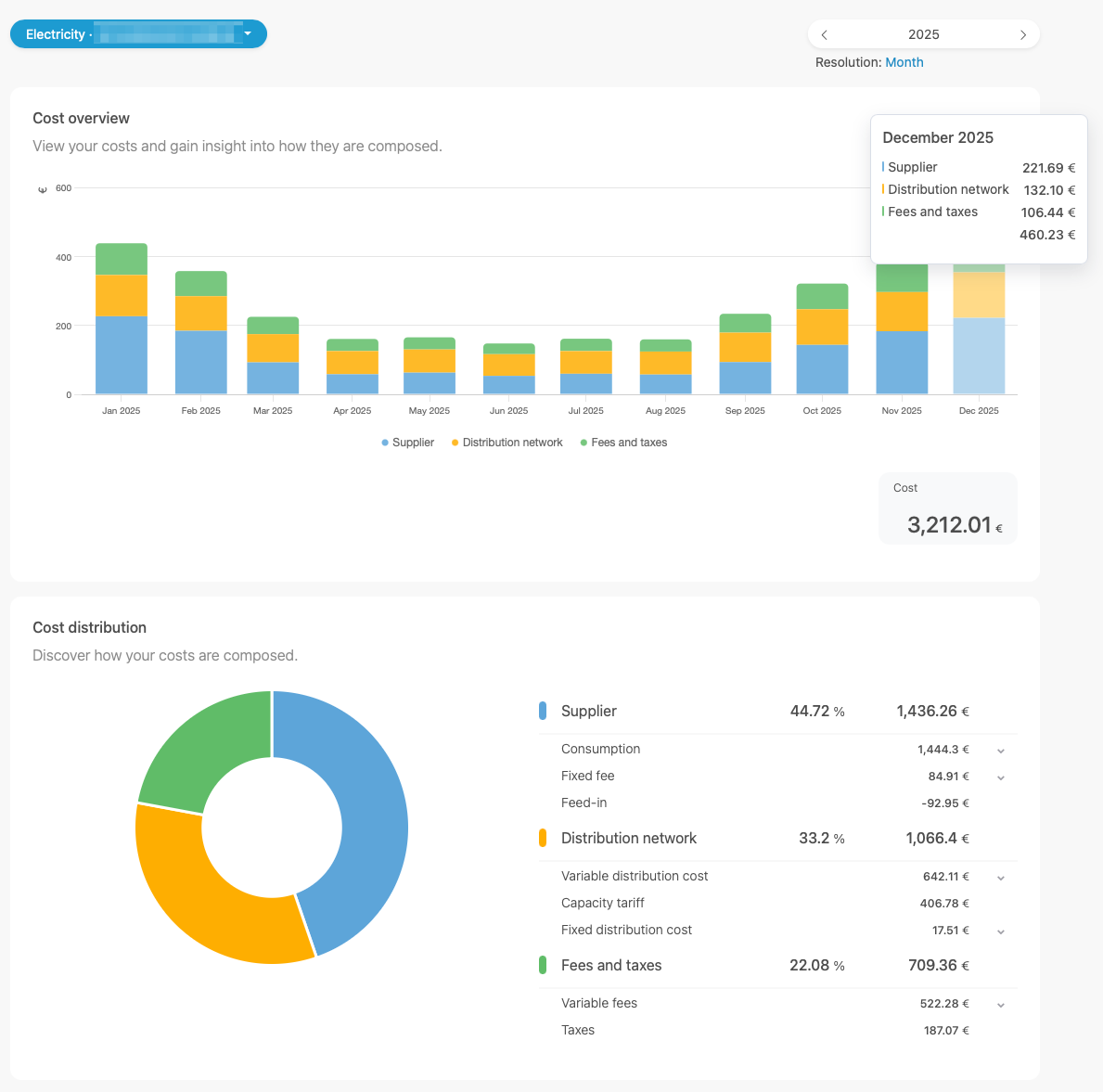
★ PreviewThe Cost analysis page gives you more insight into the estimated energy costs of your record, based on your measurement data and configured contracts.
Cost analysis is only available with EnergyID Premium via organisations that offer this feature as part of their service.
Opening the cost analysis
- Open your record.
- Go to Analyses in the menu.
- Click Cost analysis.
What do you need?
The following data is required for a useful cost analysis:
- Grid connections: these are set up automatically in your record.
More info - Contract information: this is linked automatically if your supplier supports it via EnergyID Premium.
- Digital meter data: you link this to your record via apps. In Flanders, this is done via the Fluvius integration (link in Dutch).
How to use the cost analysis
Select the grid connection you want to view costs for in the top left.
You can choose a specific grid connection or show all grid connections combined.
Select the period and resolution in the top right.
By default, the analysis shows the last 12 months at monthly resolution.
View the first chart with the cost overview.
Use the toggle to choose between the total cost or a breakdown by components such as fixed costs, variable costs, and network costs/fees.
View the second chart with the cost breakdown.
This donut chart shows the distribution by cost component, with the figures alongside.
Check the contract information used at the bottom.
Here you can see the supplier, the tariff name, and the start date of the contract.
Composition of costs
An energy bill consists of several components. At the highest level, we distinguish three categories:
- Supplier: costs you pay to your energy supplier for the energy delivered, including the fixed subscription. When feeding electricity back into the grid, for example via solar panels, this amount can also be negative.
- Distribution network: costs for the use of the distribution and transmission network. Your supplier passes this amount on to the network operator.
- Fees and taxes: taxes and excise duties that your supplier passes on to the government.
Within each category, costs are generally fixed or variable:
- Fixed costs remain the same regardless of how much energy you consume. Examples: the subscription with your supplier, the data management fee of the distribution network operator.
- Variable costs increase with your consumption. Examples: the energy offtake cost, transport and transmission costs, excise duties.
Exception: the capacity tariff in Flanders falls outside the classic breakdown. This tariff is calculated based on power peaks, not energy consumption. More info: capacity tariff and network tariffs on the website of the Flemish Energy Regulator (in Dutch).
For more insight into your capacity tariff, there is the Capacity analysis.
Current limitations
At this time, there are still some limitations:
- The cost calculation currently uses only the current contract.
If you recently changed contracts, you will not automatically see a complete history across multiple contracts. - Manual meter readings are not supported in the cost analysis.
How index parameters work in the cost analysis
For variable and fixed contracts, the index values used only become final at the end of the month. For the current month, we therefore use the value from the previous month as an estimate. Once the effective index is published, the calculation is updated. We aim to update this as soon as possible after the start of each month, but small delays are possible.
For dynamic contracts, the index parameters are available in time, so this monthly estimate is not needed.
This is an estimate of your costs.
Your costs are calculated based on the measurement data in this record and your configured contracts. If measurement data is missing or incomplete, the result may differ from your actual costs.
The data in this analysis consists of informative meter data and may differ from the final billing data used by your supplier. We do our best to approximate your invoice as closely as possible, but discrepancies remain possible.
How we calculate
EnergyID calculates costs based on your measurement data and the tariff structure of your contract. The calculation logic — including the amounts for the various distribution network operators, excise duties, and taxes — has been made open source.
The tariffs of energy suppliers are not included in the open source repository: they change too frequently to maintain accurately. This information is provided by your supplier via EnergyID Premium.
You can consult the calculation logic and tariff data via GitHub: github.com/EnergieID/energy-cost.
Do you see an error or is data no longer up to date? Via GitHub you can submit a report or propose a correction yourself.